Spotify says 390 million of its users have now watched a video podcast, and the platform is openly courting TV producers to feed the boom. The message from inside the company is that podcasting now behaves like television, only faster, cheaper and always on.
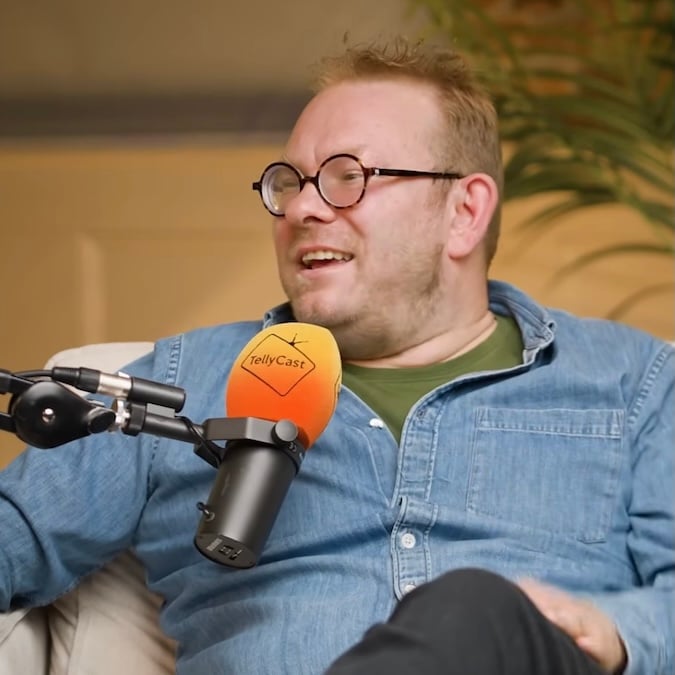
Rowan Collinson (pictured) has been at Spotify for seven and a half years, working on podcasts since the company pushed into the medium in 2017. Speaking to Justin Crosby on TellyCast in the Summer, Spotify’s UK audience lead, whose brief is editorial and audience growth, set out why video now sits at the centre of that job.
The numbers explain the priority. “Our users love video. 390 million of them have watched a video podcast on platform. 70 per cent have watched video in the foreground,” Collinson says, calling the move “a very natural evolution for us”.
Video has fixed podcasting’s discovery problem
His account of the shift is simple. “Audio podcasts were fantastic because they allowed creators to build an audience by intimacy and routine,” he says. “But discovery was always a real problem. Audio has always been really hard to market.”
Creators started filming their shows to make clips for social media, and the logic ran on from there. “That journey has gone to, well, if you’re recording clips, why not publish the whole thing? Video has really supercharged discovery and reach for those creators now.”
The podcast, in his telling, has become “the centrifugal piece of your ecosystem as a creator. It’s the living and breathing thing that every week can allow you a content funnel to feed your different social channels, and it can build a community which allows you to go into live, into merch, into newsletters.” Crosby calls the same model the octopus strategy: owned IP at the centre, each tentacle a revenue line.
For producers and publishers, Collinson argues, the pitch is twofold. “It’s about reach, and that can be local reach but also global reach, and also now revenue with the Spotify Partner Program we’ve launched. Reach and revenue are two different things, and Spotify are able to offer that.”
Always-on beats the six-part commission
Where the conversation gets uncomfortable for traditional producers is cadence. “It’s a real step change for people who’ve worked in traditional TV production, where you’ll spend six to 12 months developing an idea, filming it, delivering six episodes to a broadcaster and saying, well, that’s that,” Collinson says. “For Spotify, that doesn’t really work, because the content which works best on our platform is always-on shows. Audiences love the routine.”
He puts a number on it. “To make a successful show on Spotify, you need to be always on. You need to be aiming for that magic 50 weeks a year mark. Regularity and consistency will help you build routine with your audience.”
The model rewards iteration rather than polish. Collinson points to two of the platform’s biggest shows, The Diary of a CEO, produced by Flight Story, and Goalhanger’s The Rest Is History. “If you go back five years to their first episodes, they really are radically different to what you have now. The producers really look at their data, take on board the audience feedback through comments and on social, and iterate week on week. Traditional TV producers could learn a lot from that approach.”
That looser grammar is a feature, not a compromise. “With podcasts, it’s a much more forgiving medium,” he says. “You can change your lighting in the second episode. If a format point doesn’t work, you can move it around. The audience don’t really care. If the conversation is good and the content is compelling, they’ll stick around.”
Retention data beats BARB figures
Underpinning that loop is data of a granularity television rarely sees. “Often when you make telly, you’re working in the dark, apart from some BARB figures which might have come out two years ago,” Collinson says. “Here you’ve got living, breathing data around what your audience are doing: where they are, how old they are, when they’re listening, whether they’re foregrounding or backgrounding.”
Asked which metric matters most, he does not hesitate. “What I’d be concentrating on is retention. How long are people listening to my show, where are they dropping off, what does that graph look like? If I’d had that when I was a producer 15 years ago, I would have lapped it up.”
How the Spotify Partner Program pays creators
Then there is the money. Spotify launched the Partner Program at the start of 2025 and Collinson describes the mechanics plainly. “You join the program and you upload your video to Spotify for Creators. We insert ads into it and those go out on the free tier. For premium subscribers we remove the ads, and we give you the money. It’s a win-win really.”
Crucially, the programme stacks on top of a producer’s existing commercial activity rather than replacing it. “It doesn’t stop you doing other sponsorships around that piece, whether it’s branded cushions on your sofa, burnt-in reads, or working with a third party sales house,” he says, framing the payout as consistent revenue to reinvest in the show.
Crosby pushed on the comparison every producer makes: YouTube, where a million views can deliver what many consider peanuts. Collinson would not be drawn into a per-view figure, saying it is “really hard to compare platform to platform”, but cited Australian-born true crime creator Bella Fiori, who “has been actively telling us her show is now making more money on Spotify than it was on YouTube”.
Comedy, true crime and interview shows are popping
Three genres are driving the surge, on his reading of the UK charts. The first is young, alternative comedy, and his favourite example is Finn vs History, a breakout hit of the past 18 months. “They come on in what can only be described as 1970s university lecture suits, take a historical subject and then destroy it in the most surreal way,” he says.
Interview shows are the second. In the UK, Spotify works with Louis Theroux and his team at Mindhouse, who Collinson says has “done a really great job of transferring his unique style into that format”, while in the US, he noted, Amy Poehler’s Good Hang won a Golden Globe earlier this year. Romesh Ranganathan’s video interview show has become one of the platform’s biggest within six months of launch. “It’s a format the audience really can’t get enough of, relatively easy to produce, giving talent the opportunity to talk in depth about things they’re passionate about.”
True crime is the third, and it carries the clearest lesson for TV companies. Curve Media, a traditional factual producer, built the weekly show Totally True Crime, led by creative lead Naomi Channell, using public domain video and body cam footage. “Stuff that you would have done in traditional TV production, translated into this space,” Collinson says. “They’ve been able to make a really cost-effective, always-on show which is building audience and bringing in revenue, which they’re now using to explore other areas.”
One gap remains conspicuous. “We’d definitely love to see more longer-form content with younger female Gen Z creators. That group has been served very well by short form and vertical video, but there’s definitely room in that market for more voices.”
The majors are already moving in
The institutional money has noticed. Channel 4 now distributes Channel 4.0 content on Spotify, including the Nella Rose format Don’t Get Cancelled. “Credit to Channel 4 for being really forward thinking in this space,” Collinson says. “They understand that Spotify is a home of younger, diverse audiences, so it’s an absolute perfect fit.”
Radio groups are converging on the same territory, with Global and Bauer now major visual podcast players. Collinson credits Global’s “ambition and energy in this space”, singling out its acquisition of Fellow Studios. “They’re a fantastic studio who really understand Gen Z audiences. If I was wanting to reach young audiences, I’d want to be buying them as well.”
Nor is the door reserved for giants. Spotify works with everyone from traditional TV production companies to bigger operators such as Goalhanger and solo independents. “Anyone can join,” he says of the Partner Program. “If we feel the content is strong and there’s an opportunity, we’d love to hear from you.”
What changes next
Collinson’s advice for the next two to three years is blunt. “I just think do it. People spend too much time thinking about things. If you’ve got access to talent and exciting ideas, or IP you can potentially reversion, just go for it. The barrier to entry now is so much lower than it was even two years ago.”
He believes TV producers arrive better armed than they realise. “You’ve got access to people with great talent, people who know how to make something look good and understand the pacing of visual content. When you combine that with people who understand the digital landscape and the power of podcasting, that intimacy and routine, you can have a lot of success there.”
The direction of travel is clear enough to plan against. The winners will be producers who trade the six-part delivery mindset for 50-week formats, read their retention graphs weekly and design shows as ecosystems from day one, and broadcasters who, like Channel 4, treat the platform as a route to young audiences. The losers are those who wait for the market to look like television before entering, because by then, as Collinson puts it, the plane being built in flight will already have taken off without them.