

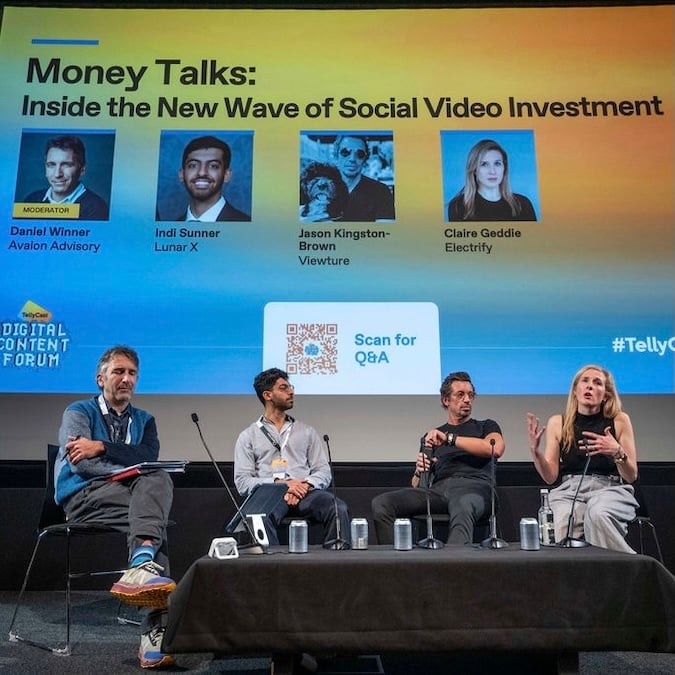
For most of the last decade, investing in YouTube channels and creator businesses was treated as a speculative sideshow: interesting, occasionally lucrative, but not the kind of asset class that a pension fund or private equity house would touch. That has changed markedly in the past eighteen months, and the shift was laid out in detail at TellyCast’s Digital Content Forum, where three of the UK’s most active investors in the space, Indi Sunner of Lunar X at the time of the panel, Jason Kingston-Brown of Viewture, and Claire Geddie of Electrify, joined moderator Daniel Winner to explain why the money is moving now, and what it expects in return.
The scale of that movement is hard to ignore. In the weeks before the panel, three companies represented at the same event had all taken on fresh capital. The Fellas had been bought by Global Media. Arcade Media, the holding company behind Sideman, had taken investment from the media company Lumina. And Flight Story, which operates Diary of a CEO, had raised a nine figure sum from Slow Ventures, a fund that specialises in creator businesses, valuing the company at more than $400 million. Collectively, the panellists said, billions of dollars are now being deployed into social video.
From hype to underwriting
The obvious question is why this is happening now, when YouTube has existed for two decades and the MCN investment boom of a decade ago ended in disappointment for many backers. According to Kingston-Brown, the difference is that capital used to chase excitement rather than evidence. Early interest, he said, was driven by virality and visibility rather than anything an underwriter could stand behind. What has changed is that institutional investors can now treat creator businesses as measurable media companies, with the data, analytics and revenue history that private equity expects from a conventional acquisition. Viewture’s own funding line, a facility running into nine figures, reflects that shift in credibility.
Sunner offered a concrete illustration from his own experience at Berg, the YouTube investment business that was later sold to one of the world’s largest private equity firms. When Berg first began investing in channels, more than ninety per cent of the revenue those businesses generated came from YouTube AdSense alone. By the time the company was sold three years later, over half of its revenue was coming from sources beyond the platform, with consumer products the single largest contributor. That transition from a single, unreliable revenue line to a diversified income base is, in Sunner’s view, the clearest evidence that these businesses can behave like conventional media companies, and it has done more than anything else to build investor confidence in the sector’s ability to deliver returns.
What makes a channel investible
Both Electrify and Lunar X operate as owner-operators, acquiring between fifty and one hundred per cent of a business and running it as a joint venture with its founder. Geddie described Electrify’s threshold as roughly seven figures in profitability, alongside a preference for content that is high quality but also evergreen, since that predictability of future value matters as much as current earnings. Valuations across both firms tend to sit within a rough multiple of three to six times profit, adjusted up or down for growth rate, a method that will look familiar to anyone who has priced a traditional production company.
What has shifted more subtly is how these investors think about audience size. Geddie noted that the old correlation between subscriber count and business quality has given way to something closer to a thousand true fans model, in which a smaller, deeply engaged and portable audience matters more than raw scale. Both she and Sunner also pointed to a set of operational signals that sit alongside the financial ones: watch time and viewership development, monetisation performance, and what Sunner called key person risk, meaning how dependent a business is on one individual’s continued presence and output. Geddie was candid that some of the judgement remains qualitative. Comment analysis can offer a proxy for a founder’s relationship with their audience, but she admitted there is still a degree of gut feel involved in assessing what she called emotional resonance, a factor she conceded her own data science team would rather she did not describe that way.
Two very different models of capital
The panel also revealed a meaningful split in how this money is structured. Lunar X and Electrify take equity, buying into the business and working with founders towards a defined outcome, whether that is a long term joint venture or an eventual exit. Viewture takes the opposite approach, providing funding without taking ownership or control, in amounts that Kingston-Brown said could range from a hundred thousand pounds to fifty or a hundred million, depending entirely on what a business needs and what the data supports. Around sixty per cent of Viewture’s deal flow now comes to them directly rather than through outbound sourcing, which Kingston-Brown attributed partly to the firm’s own origins as a creator-founded business.
For channels that do take on equity investment, the post-deal relationship is deliberately staged rather than immediate. Sunner described splitting responsibilities into three categories: administrative functions such as sponsorship negotiation, contracts, finance and legal, which founders are typically glad to hand over quickly; production, which requires a slower, more considered transition built around what a founder actually enjoys doing and where they remain essential; and commercial development, where the investor’s infrastructure helps bring larger projects such as product lines or documentaries to life. Electrify’s model looks similar in structure but heavier in production resource, with dedicated end-to-end teams built around individual properties such as Veritasium and Vsauce, backed by a data science function, a commercial development team and a brand sponsorships operation selling premium inventory.
What this means for the wider industry
The implication for traditional production companies is not that they should expect a wave of acquisition offers, but that the underwriting logic now being applied to creator businesses is one they will increasingly be measured against. Diversified revenue, evergreen IP, reduced dependency on a single individual and demonstrable audience engagement are becoming the standard tests of investability across the wider content industry, not just its digital-first corner. When asked what advice they would give a creator business hoping to attract capital, all three panellists converged on a similar answer: build something that looks and behaves like a company rather than a personality, surround yourself with proper commercial and legal support, and prioritise recurring revenue over anything spiky or unpredictable.
Winner closed the session with an analogy that captured the mood of the room. The YouTube ecosystem, he suggested, has moved on from being an awkward teenager to something closer to a responsible adult, and responsible adults are the ones who get handed money to invest. For an industry that has spent much of the last five years wondering how seriously to take the creator economy, that maturity is arguably the more significant headline than any single funding round.
More info and tickets to this year’s visit TellyCast Digital Content Forum