
Global investment bank Goldman Sachs reckons the creator economy could be worth $480 billion by 2027. No wonder traditional and non-traditional investors are lining up to back the next generation of talent
For much of the past decade, creators have built businesses largely on their own. Platforms such as YouTube offered distribution and ad revenue, but there were few formal financial structures on offer. If a creator wanted to scale their brand, diversify revenue or step back from the relentless pace of production, the options were limited.
That is no longer the case. Across the industry, a broad array of companies are now treating creator-led media brands as a legitimate investment category.
One of the earliest signs of this shift came from companies experimenting with new financing models for creators. Among the most prominent is Spotter, which provides upfront capital to YouTube creators in exchange for licensing the monetisation rights to their existing video catalogues for a fixed period, typically around five years.
This model allows creators to access funding without giving up equity or ownership of their channels. Instead, Spotter pays for the rights to monetise older videos, effectively turning past content into a financial asset that can be reinvested into future growth.
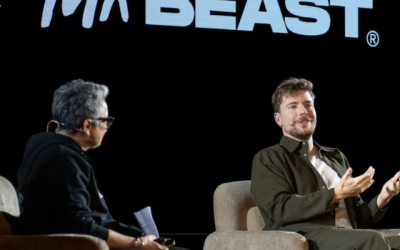
Since launching in 2019, the company says it has deployed more than $940m to creators including MrBeast, Dude Perfect (pictured), Colin & Samir and Airrack. Many use the funding to hire production teams, build studios or launch new ventures. In the case of creator collective Dude Perfect, the group has since gone on to secure $100 million of investment from Highmount Capital – for brand-building beyond video.
A simple and transparent model, Spotter’s approach soon attracted attention from tech companies. In 2024, Amazon acquired a minority stake as part of a partnership aimed at expanding opportunities for creators in content development and retail.
This model isn’t just significant because it unlocked working capital for creators. It has also acted as a proof point, demonstrating that digital-first businesses have the potential to scale and sustain. Partly as a result, they now have a wide range of options.
Alongside the Spotter-style approach, some players have started to acquire equity stakes in creator businesses. At the same time, VC firms are looking to back creators as founder/entrepreneurs. Meanwhile, agencies and talent management companies are also deploying their own capital and resources to help clients build companies.
Taken together, these approaches have created a nascent financial ecosystem around digital talent one that increasingly resembles the studio system of traditional media.
One of the most direct ways investors are entering the creator economy is via acquisition. Lunar X, for example, takes majority stakes in creator-led companies like Theorist Inc, which runs a series of thematically-linked YouTube channels.
Tobias Hoss, former senior advisor at Lunar X, says the company focuses on creators who are ready to scale, providing both liquidity and operational support while treating their content as the starting point for a business development programme.
At the heart of Lunar X’s model is what Hoss calls a franchising approach. The company identifies the core IP and audience of a YouTube channel, then works with creators to expand into new revenue streams merchandise, events, music, licensing, and international distribution. This transforms a single content channel into a diversified media business.
For example, one investment in the US saw Lunar X launch a fashion line, establish retail partnerships with major stores, sign plans to ensure the brand remains sustainable even if key talent step back. Coupled with earn-outs, profit-sharing, and milestone-based incentives, these measures align interests and keep creators engaged while giving them an opportunity to “take chips off the table” without relinquishing the focus that built their audience. Beyond individual investments, Lunar X leverages scale across its portfolio. Shared resources allow the company to negotiate better rates and benchmark performance across channels. This critical mass effect means smaller or mid-sized creator businesses gain access to deals and platforms that would otherwise be out of reach, accelerating growth and diversifying revenue while professionalising operations.
Electrify takes a similar approach: “We’re an owner/ operator of creator-founded content brands,” explains director of creator partnerships Claire Geddie. “We take equity stakes in companies then run the businesses together.”
The company’s portfolio includes documentary channels Fern and Veritasium, and coding-focused and channel Fireship. Echoing Hoss, Geddie says much of the company’s value comes from deep operational and strategic support designed around the individual creator. “At the core, we’re helping creators step off what we call the ‘hamster wheel’ of content creation,” she explains. “Many founders are still putting in incredibly long hours. Our role is to provide the scaffolding that allows them to scale, maintain quality, and reclaim work-life balance, without slowing growth.”
This support is multi-layered. On the content side, Electrify works with creators to build reliable, cross-platform publishing pipelines, making sure there’s always a bank of content ready for holidays, sabbaticals, or unforeseen pauses. From thumbnails and titles to platform-specific strategy, every detail is optimised to reach audiences while keeping the creator’s vision intact. Beyond content, the company helps assemble teams that combine subject-matter expertise with storytelling talent.
Commercially, Electrify plays an active role in identifying revenue opportunities and expanding the creator’s ecosystem. This can range from brand sponsorships to live events, merchandise, or even new digital products. Financial and data support is also central: creators gain access to accounting, analytics, and audience insights, helping them understand engagement patterns and how to grow their brand sustainably.
The overarching philosophy, Geddie emphasises, is to amplify the creator’s voice without compromising it. “We don’t want to dilute a creator’s authenticity,” she says. “We want to take their secret sauce and put rocket fuel behind it – scaling the brand while preserving the editorial vision audiences love.”
Venture Capital (VC) firms are also investing significant sums in creator-led businesses. Slow Ventures, founded by a trio of tech entrepreneurs, has assembled a $60m vehicle called the Slow Ventures Creator Fund. The stated plan is to back around 20 creators with investments ranging from $1m-$3m in return for roughly a 10% stake.
Rather than targeting celebrity creators, the fund focuses on founders who have built strong communities in specialised verticals – areas such as health, hobbies or professional education. The strategy reflects a belief that creators are often building businesses in reverse compared with traditional startups.
Slow Ventures describes the strategy as “betting on a new generation of founders who’ve built their community first and their business afterward – an inversion of the traditional VC-backed founder”. One early example is physiotherapist and creator Tayla Cannon, whose digital platform Rebuildr helps clinicians run online practices.
Explaining the firm’s investment philosophy, Slow Ventures partner Megan Lightcap says: “We talk a lot about ‘person and theme’ – and how we closely evaluate those criteria when deciding to invest in a founder or creator. We must have strong conviction in the person as a resilient, driven entrepreneur and the category in which they’re operating as important and growing. There should be compelling tailwinds or changing dynamics that create whitespace for new value creation and capture. When you add a creator’s community to this mix, the opportunity becomes even more compelling.”
Not all investors in the creator economy are buying equity. There is also a growing roster of agencies and brokers more interested in building businesses around creators than owning them outright. A case in point is influencer marketing and talent company Viral Nation. Originally known for connecting brands with social media personalities, the company has expanded into talent management, strategy and IP development. Rather than taking stakes, its approach is to work alongside talent as partners – helping them turn successful channels into broader media businesses.
“We’re about helping creators grow their business,” says Viral Nation head of programming Paul Telner. “A lot of creators are out there doing their thing and we help develop them – building strategy, monetising brand deals and expanding what they do.”
That support can take many forms: negotiating brand partnerships, helping creators develop consumer products, refining their platform strategy or introducing them to producers and studios who can turn their ideas into new formats. One example is the McCartys, a family that creates content blending sketch humour with Halloween-themed characters and storylines. After identifying the channel’s potential, Viral Nation began working with the family to expand their IP beyond short-form social videos.
The company connected the family with producer Catherine Winder, a veteran animation executive known for building global franchises. Together they began developing new projects based on the McCarty universe, including an animated concept and a competition-style format set in a fictional spooky summer camp.
In this instance, the investment was not financial in the traditional sense. Instead, Viral Nation provided the strategic guidance, industry introductions and development expertise needed to turn a creator channel into a potential cross-platform franchise.
Telner argues that this kind of partnership reflects a broader shift in the landscape. “Creators have become their own studios,” he says. “They already have the audience and they understand what their audience wants. Our job is to help take what they’ve built and expand it.” For creators, the benefit can resemble taking on an investor – access to expertise, networks and infrastructure – without giving up ownership.
Echoing Geddie, Telner says the digital-first opportunity is not limited to the biggest internet celebrities. “There’s a whole middle layer of creators who can build real businesses,” says Teller. “They don’t all have to be MrBeast.”
Another interesting development is the growing number of leading talent agencies looking to move beyond basic representation. A case in point is YMU Group, which recently launched its YMU Venture Fund. This fund is designed to invest in businesses founded or co-created by agency talent across media, sport, culture and commerce.
According to YMU chief executive Mary Bekhait, the fund reflects a broader shift in how talent businesses are evolving. “The economics of talent have fundamentally changed,” she says. “Influence now compounds into ownership, IP and enterprise – not just fees.”
Rather than simply negotiating deals, YMU wants to help creators build companies. The fund will focus on ventures spanning content IP, production businesses, product brands and digital platforms, building on relationships with Fearne Cotton’s wellness platform Happy Place and Ant and Dec’s production company Mitre Studios, for example.
Another significant illustration of how far things have shifted is the fact that creators themselves are becoming investors. Jellysmack is a prominent example, but just as noteworthy was the decision by YouTube group The Sidemen to launch their own VC operation Upside in partnership with entrepreneur Jamie Elliott.
That said, it is also worth noting that so far Upside has focused on backing tools rather than onscreen talent – an example being AI-powered content strategy and creation platform, POCKLA. In this sense, it sits alongside companies like Lumina and Whalar, which are investing in the tools, studios, and platforms driving the sector’s growth. Taken together, all these models – acquisitions, VC, agency partnerships and talent-backed funds – illustrate how quickly the economics of digital media are evolving. For creators, the result is a growing range of options to scale their businesses, capture the value they generate and perhaps avoid burnout in the process.
Six questions for creators to consider before taking investment
1 What problem is the investment solving?
Money is only one reason to bring in a partner. Many creators reach a point where the real bottlenecks are operational – hiring staff, managing brand deals, scaling production or negotiating with distributors. The key question is whether the investor brings capabilities that solve specific problems.
2 Speed & culture fit
Creator businesses often move far faster than traditional media companies. New formats can be tested in days and audience feedback arrives instantly. A slow-moving investor can become a drag on that process, so founders need partners whose decision-making speed and working style match their own.
3 Creative control
The value of most creator businesses lies in the personality and authenticity of the talent at the centre. If investment comes with heavy editorial oversight or corporate sign-off processes, it risks diluting the voice that attracted the audience in the first place. Clear expectations around creative autonomy are essential.
4 Ownership and long-term value
Equity deals can unlock immediate growth, but they also mean sharing future upside. Creators should think carefully about what percentage of their company they are willing to give up and whether the partner’s involvement will meaningfully increase the long-term value of the brand.
5 Infrastructure and distribution
The best partners often provide access to resources that are difficult to build independently – advertising sales teams, brand relationships, legal and finance support, marketing channels or international distribution. In many cases, those capabilities end up being more valuable than the investment itself.
6 Succession strategy
Many creators reach a point where they want to reduce their day-to-day involvement in the business they have built. The right investor can help put teams, systems and processes in place so the company continues to grow without relying entirely on the founder. Creators should consider whether the investors they are talking to will ensure the business is in safe hands if they decide to step back from their “baby”, and how that shift might affect their level of control and involvement.