
Every digital studio runs on a stack of people, kit and software it rarely shows anyone. What’s Our Stack, a new regular feature on The Drop, asks producers to draw theirs.
The television industry is good at talking about what it makes and poor at showing how it makes it. Commissions and formats are discussed in public, but production workflows are not. Yet for digital-first studios the workflow is where the margin lives: how many people a shoot needs, which tasks software has taken over, and where a human still makes the call.
We want digital video businesses to draw their technology stacks as a single picture. One studio, one workflow, one graphic, published with a short account of why it works the way it does.
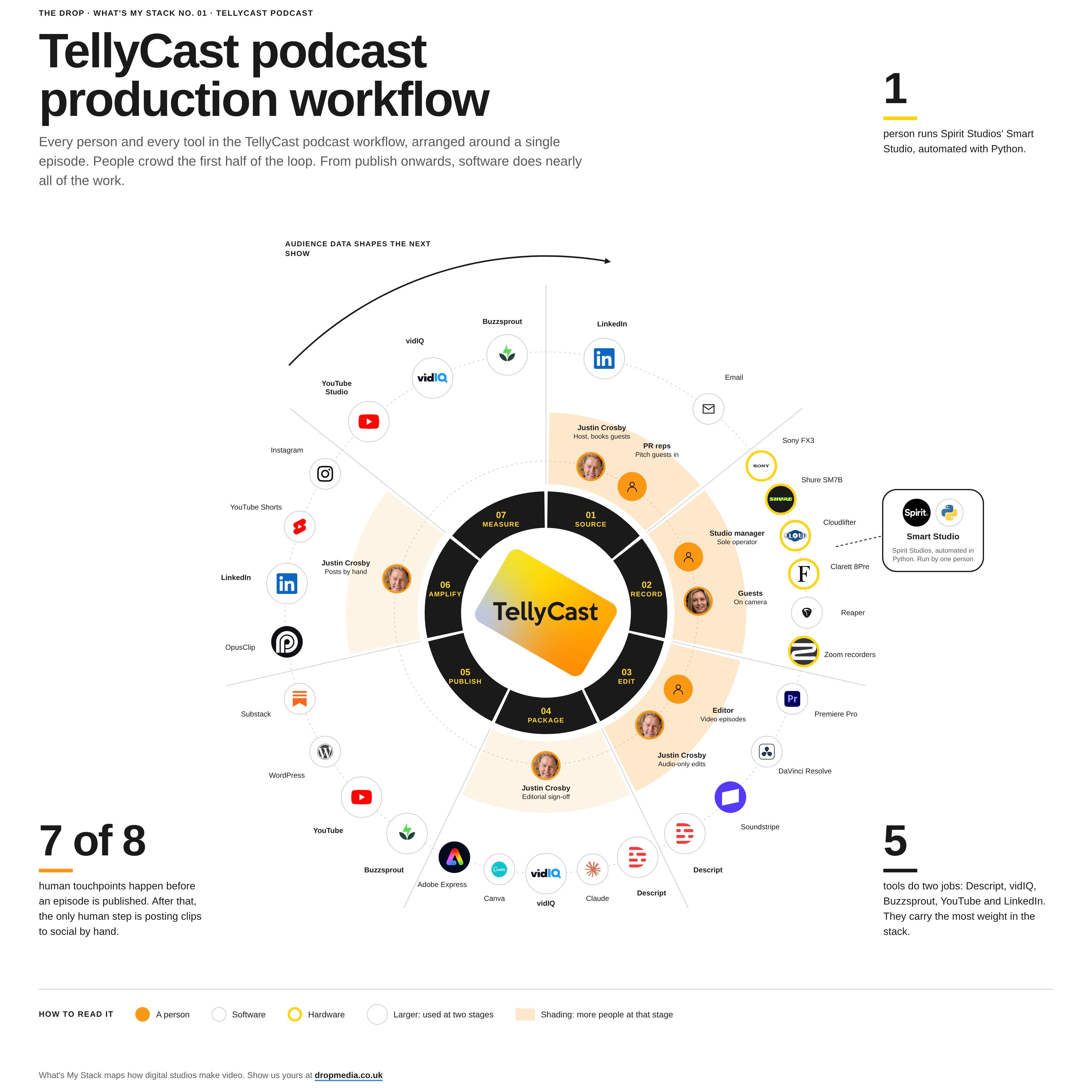
We started with our own. The first edition maps the TellyCast podcast production workflow across seven stages, from sourcing guests to measuring the audience. Every tool appears as its logo and every person as a face or a role.
Three things stand out. Seven of the eight human touchpoints happen before an episode is published, and after that the only manual step is posting clips to LinkedIn and Instagram. Five tools do two jobs each, with Descript both editing audio-only episodes and transcribing every show. And the studio is run by one person: Spirit Studios’ Smart Studio is automated with Python, so a single studio manager sets up and runs each weekly recording.
None of this is unusual on its own. Together, it shows where craft and judgement now sit in a small digital production: at the front of the process, in choosing guests, running the studio and making the edit. Once a master file exists, software does most of the multiplying.
Show us yours
We are inviting digital studios, creator businesses, independent producers and broadcasters’ digital teams to submit their own stack. The more varied the entries, from single-format channels to multi-platform studios and distribution businesses, the more useful the comparison becomes. To take part, send us:
- Your workflow as a 300 dpi infographic (jpeg or png file) in stages, from idea or source through to measurement, using our seven stages or your own
- every tool and piece of kit at each stage, with official logo files where you have them
- where people are involved, by role
- a few lines introducing your workflow, what has changed in the past year, and what you would change next